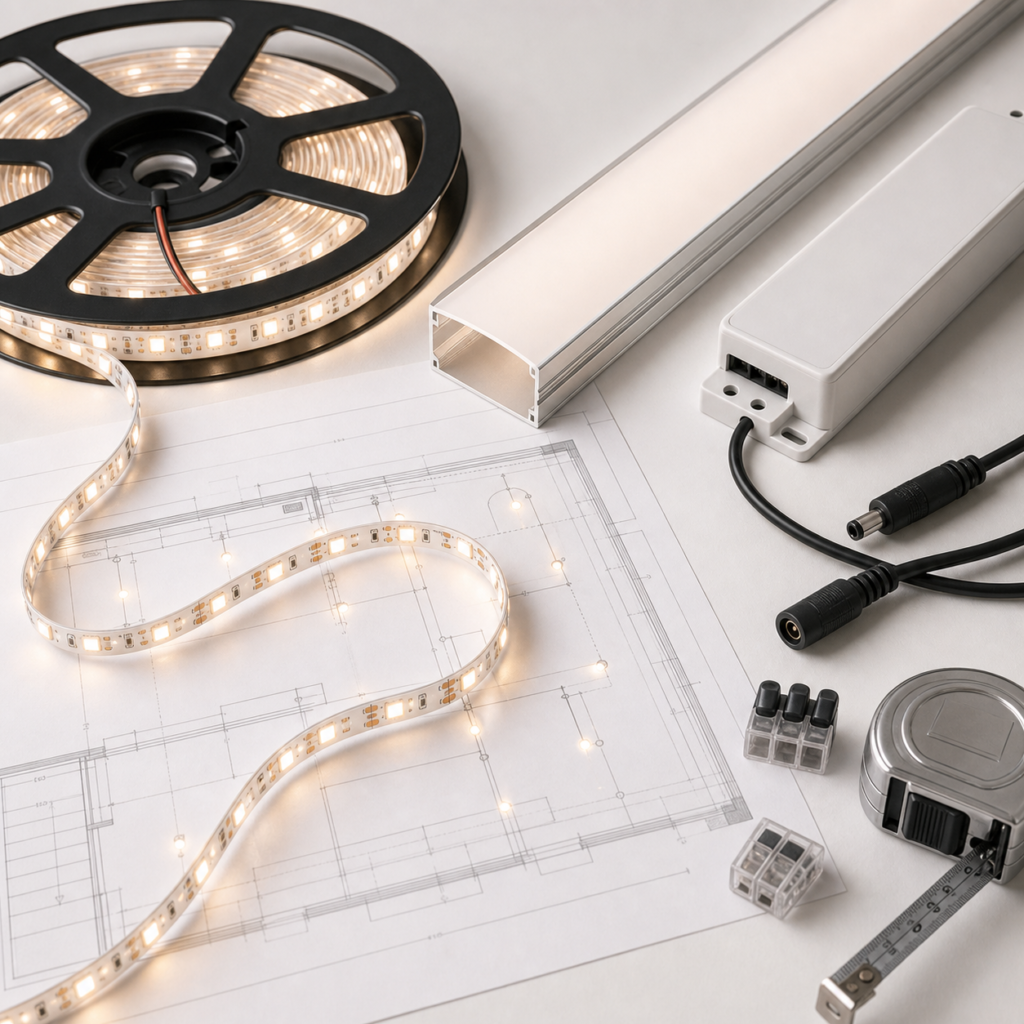
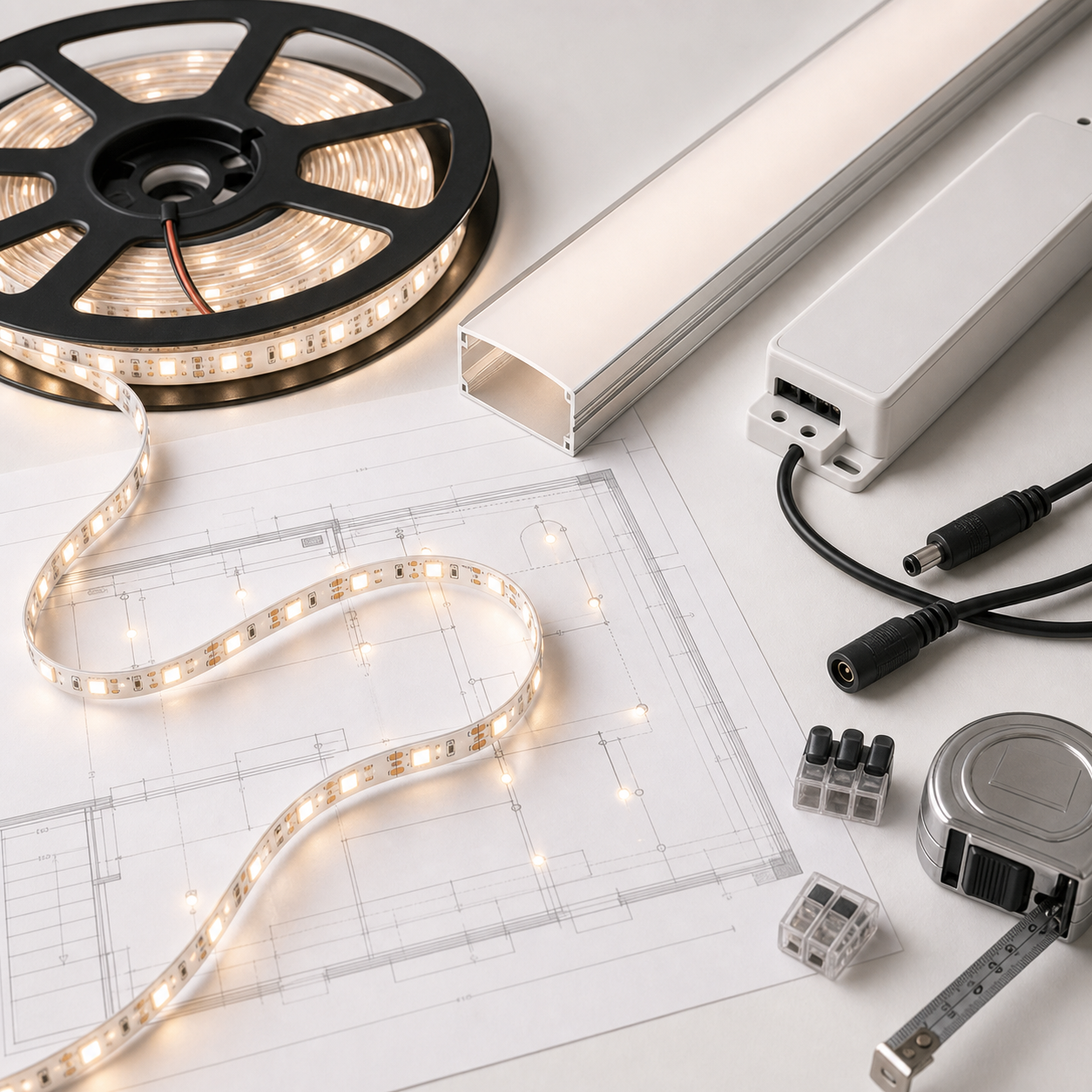
Large-scale engineering projects need lighting products that are easy to specify, consistent across long runs, and reliable after installation. That is why the question is not only which LED strip light looks bright in a sample box. The real question is whether the strip, driver, controller, profile, wiring method, and installation plan can work together across the full project.
LED strip lighting is used in hotels, shopping malls, offices, retail stores, architectural ceilings, outdoor facades, signage details, stair lighting, and landscape features. It can create clean lines, hidden indirect lighting, and flexible decorative effects. But in large projects, a wrong choice can lead to color inconsistency, voltage drop, overheating, visible dots, early failure, or difficult maintenance.
This guide explain the main points project buyers, contractors, designers, and lighting distributors should check before ordering LED strip lights in bulk. For related project lighting options, Enton Light also supplies indoor lights, outdoor lights, and all products for commercial lighting packages.
Start With the Project Application
The first step is to define where the LED strip light will be used. A hotel cove ceiling, an outdoor facade, a supermarket shelf, a staircase, and a signage outline do not need the same strip. The installation environment decides the brightness, IP rating, voltage, diffuser, color temperature, and control method.
For indoor decorative areas, visual comfort and smooth light are often more important than maximum wattage. For outdoor or semi-outdoor projects, waterproof protection, UV resistance, cable sealing, and safe power supply placement become more important. For retail displays, CRI and color consistency can strongly affect how products look.
Project teams can compare LED strip lighting with other fixture types such as recessed downlights, track lights, and pendant lights. A complete lighting scheme usually uses more than one product type.
Check Voltage Before Checking Price
Voltage is one of the most important technical decisions for LED strip lighting. Common strip voltages include 12V, 24V, and sometimes higher-voltage options for long-distance applications. In large-scale projects, 24V is often preferred because it can reduce current compared with 12V at the same wattage, which helps with longer runs and voltage drop control.
Voltage drop means the strip becomes dimmer toward the far end of the run. This is a common problem when a long strip is powered only from one side. It can make one end of a cove or shelf look warm and bright while the other end looks weak. To control this, engineers may use shorter feed sections, larger wire size, power injection, parallel wiring, or more distributed drivers.
Before approving a sample, ask for the recommended maximum run length, the wattage per meter, and the wiring diagram. A strip that looks fine at two meters may not perform the same across 30 meters of project installation.
Calculate Wattage, Driver Capacity, and Load Margin
Every engineering project needs a clear load calculation. Multiply the LED strip wattage per meter by the total installed length, then add a proper safety margin for the driver. Many project teams avoid loading drivers at 100% capacity because heat and long operating hours can reduce reliability.
For example, if a strip is 10W per meter and the project uses 200 meters, the total strip load is 2,000W before adding margin. That load should be divided into safe circuits with suitable drivers, cable routing, and control zones. This planning is more important than only finding a cheap strip price.
The U.S. Department of Energy LED lighting guide explains why LED technology is efficient and widely used across product types. For project buyers, efficiency is useful only when the system is designed correctly from strip to driver.
Choose the Right Brightness and LED Density
Brightness should match the purpose of the light. A soft cove ceiling does not need the same output as a retail shelf or task-lighting detail. Too little output makes the project look unfinished; too much output creates glare, wasted power, and sometimes heat problems.
LED density also matters. Low-density strips can show visible dots when installed behind a shallow diffuser or reflective surface. High-density or COB-style strips can create smoother lines of light, especially in aluminum channels or narrow architectural slots.
When choosing LED density, check:
- LEDs per meter and the spacing between light points.
- Whether a diffuser or silicone cover will hide the dots.
- The distance between the strip and the illuminated surface.
- The required lumen output per meter.
- The heat dissipation method, especially for high-power strips.
Select CCT and CRI for the Actual Space
Color temperature, also called CCT, changes the feeling of a space. Warm white is common for hotels, restaurants, villas, and lounges. Neutral white is often used in offices and retail spaces. Cooler white may be used in some service areas, warehouses, or technical rooms, but it can feel too cold in hospitality projects.
CRI is also important. Higher CRI helps surfaces, products, food, fabrics, and finishes look more natural. Retail and hotel projects usually benefit from better color rendering, while basic utility areas may accept a lower requirement.
For large-scale projects, do not mix different LED bins casually. Ask whether the supplier can keep color consistency across the batch. If the project is installed in phases, confirm whether future repeat orders can match the original CCT and appearance.
Decide Whether You Need Single Color, CCT Tunable, RGB, or RGBW
LED strip lights can be single color, CCT tunable, RGB, RGBW, or addressable. The right choice depends on the control requirement.
- Single color strips are simple and stable for most cove, shelf, and indirect lighting.
- CCT tunable strips allow warm-to-cool adjustment for hospitality, meeting rooms, and multi-scene spaces.
- RGB strips are useful for decorative color effects but are not always ideal for high-quality white light.
- RGBW strips add a dedicated white channel, making them more flexible for projects that need both color and usable white light.
- Addressable strips can create dynamic effects, but they need more careful controller and programming planning.
Enton Light also has project lighting products in categories such as solar lights, outdoor wall lights, and solar wall lights for projects that combine decorative strip lighting with exterior fixtures.
Match the IP Rating to the Environment
IP rating should match the real installation environment, not only the sales description. Indoor dry coves may use a lower IP rating. Bathrooms, kitchens, exterior facades, signage, gardens, and semi-outdoor areas need stronger protection against moisture and dust.
For outdoor or wet areas, check how the strip is sealed after cutting. Many failures happen at cut points, connectors, or cable entries. The strip may be waterproof, but the field connection may not be. For large projects, installation method is part of product selection.
Also check whether the strip will be exposed to UV, cleaning chemicals, high humidity, or heat. A silicone sleeve, PU coating, or IP67/IP68 structure may be needed depending on the site. Engineering teams should ask for test data and installation instructions before mass order.
Use Aluminum Profiles for Heat and Finish Quality
An aluminum profile does more than make the strip look neat. It helps with heat dissipation, protects the strip, holds the diffuser, and gives installers a cleaner mounting surface. For high-power strips or long daily operating hours, heat management is a serious reliability factor.
Profiles also affect the final visual result. A deeper profile with a good diffuser can reduce visible dots. A shallow profile may be easier to fit but may show LED points. For premium hotel, retail, and office projects, mock-up testing is worth the time.
When possible, test the strip and profile together before approval. The strip alone on a table does not show the final light effect after installation.
Plan Drivers, Dimming, and Controls Early
Drivers and controls should be planned at the same time as the strip. If dimming is required, the driver must support the selected dimming system. If the project needs DALI, 0-10V, TRIAC, DMX, PWM, or smart control, that should be confirmed before purchase.
The DOE lighting controls overview explains common controls such as dimmers, sensors, timers, and photosensors. In engineering projects, controls can reduce energy waste and make spaces more useful, but only when all components are compatible.
For larger commercial systems, project teams may also review DesignLights Consortium resources as a reference point for commercial lighting performance, controls, and specification thinking.
Check Safety, Certification, and Documentation
For engineering projects, documentation is not optional. Buyers should ask for specification sheets, installation instructions, wiring diagrams, test reports, and certification information. The required marks depend on market and project type, but safety evaluation should be treated seriously.
UL Solutions lighting information is a useful reference for understanding safety and certification around lamps, fixtures, components, and LED equipment. For public, hotel, commercial, or government projects, certification requirements should be confirmed before ordering.
Also check the driver certification separately. A good strip connected to a poor driver can still fail. For low-voltage strip systems, the power supply, cable, connector, controller, and installation box all matter.
Ask for Samples, Then Build a Real Mock-Up
A sample strip is useful, but a real mock-up is better. Install the strip in the intended aluminum profile, with the real diffuser, power distance, mounting surface, and dimming method. Then check brightness, color, visible dots, glare, heat, and installation difficulty.
Mock-ups help avoid mistakes before mass production. They also help the client, designer, contractor, and supplier agree on the final effect. This step can save money because correcting hundreds of meters after installation is much harder.
Procurement Checklist for Large LED Strip Projects
Before placing a bulk order, project buyers should confirm:
- Application area: indoor, outdoor, wet, dry, decorative, task, or accent lighting.
- Voltage: 12V, 24V, or another required system voltage.
- Wattage per meter and total project load.
- Driver capacity, quantity, location, and safety margin.
- Maximum run length and voltage drop control method.
- Lumen output, LED density, and dot-free requirement.
- CCT, CRI, color bin, and batch consistency.
- IP rating and cut-point sealing method.
- Aluminum profile, diffuser, clips, end caps, and mounting accessories.
- Dimming, control protocol, and controller compatibility.
- Certificates, test reports, warranty, and installation documents.
- Spare parts plan for future maintenance.
How Enton Light Can Help With Project Lighting Selection
Even when a project starts with LED strip lighting, it often needs a wider lighting package. Enton Light supplies indoor and outdoor lighting categories for project buyers, including ceiling lights, surface downlights, spotlights, bollard lights, and step lights.
For product selection, bulk quantity, custom requirements, or project sourcing, buyers can browse the Enton Light shop, learn more on the About page, or send details through the Contact page. Clear drawings, quantity lists, target CCT, required IP rating, and control requirements will help the supplier recommend the right solution faster.
Conclusion
Selecting the right LED strip light for a large-scale engineering project is a system decision. The strip, driver, voltage, wiring, profile, diffuser, control method, IP rating, and maintenance plan all need to work together. A low unit price can become expensive if the product causes color mismatch, voltage drop, heat problems, or installation delays.
The best approach is simple: define the application, calculate the electrical load, test a real mock-up, confirm documentation, and work with a supplier who understands project requirements. With the right planning, LED strip lighting can deliver clean lines, flexible design, and reliable performance across commercial and architectural spaces.
FAQs About LED Strip Light Selection
What voltage is best for large LED strip light projects?
Many large projects prefer 24V because it can support longer runs and lower current than 12V at the same wattage. The final choice depends on strip power, run length, driver design, and wiring plan.
How do I avoid voltage drop in long LED strip runs?
Use shorter powered sections, feed power from both ends where suitable, choose proper wire size, use distributed drivers, and follow the supplier wiring diagram. Do not rely on one long strip powered only from one side.
What IP rating should I choose for outdoor LED strip lights?
Outdoor or wet locations usually need higher IP protection, but the exact rating depends on exposure. Also check cut-point sealing, connector waterproofing, UV resistance, and driver placement.
Are COB LED strips better than SMD LED strips?
COB strips can create a smoother dot-free line, which is useful for visible linear effects and shallow channels. SMD strips are still useful for many projects and may offer more options in output, color, and price.
Should LED strips always use aluminum profiles?
For professional projects, aluminum profiles are strongly recommended. They improve heat management, protect the strip, hold diffusers, and create a cleaner finish.
What information should I send to a supplier?
Send project drawings, total length, installation environment, required CCT and CRI, IP rating, control method, voltage preference, quantity, and photos or sketches of the installation detail.
Can LED strip lights be dimmed?
Yes, but the strip, driver, controller, and dimming system must be compatible. Confirm the dimming protocol before ordering, especially for DALI, 0-10V, TRIAC, DMX, PWM, or smart control systems.