
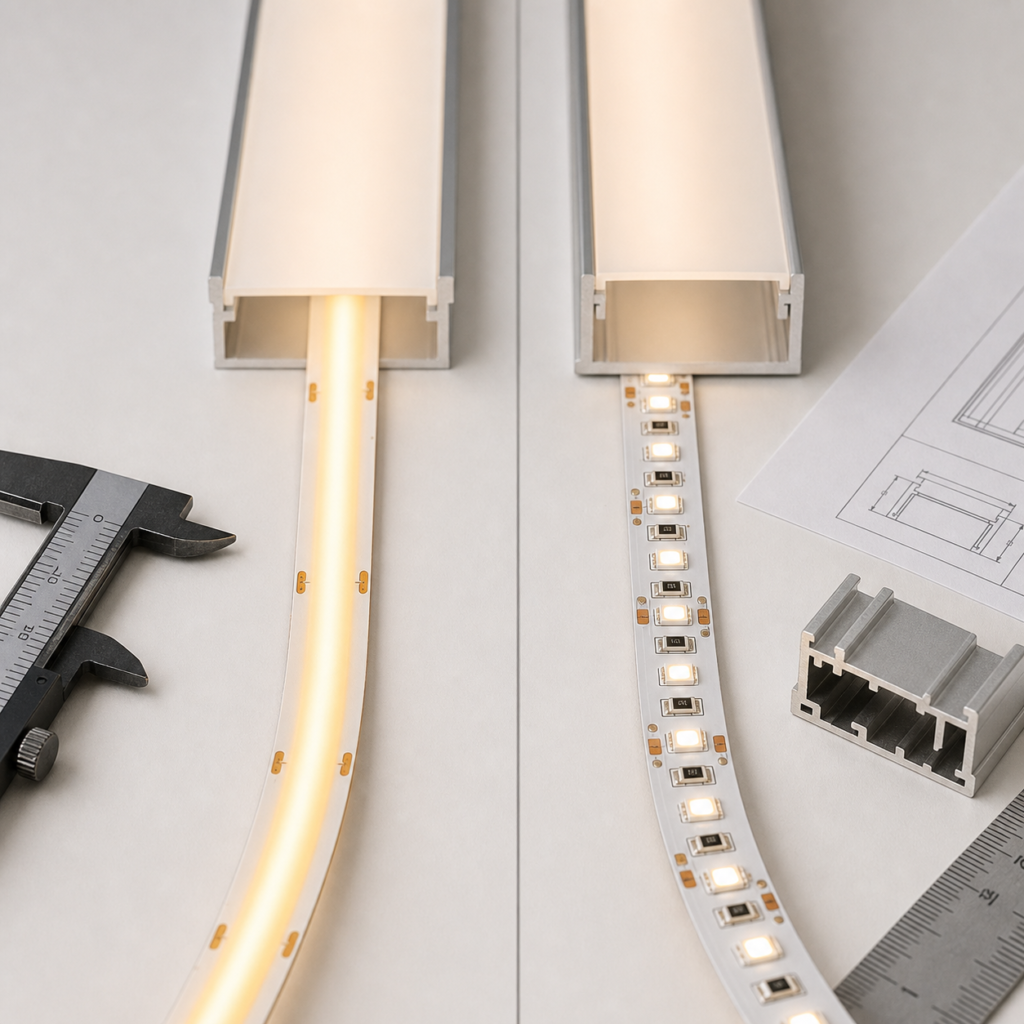
For professional lighting buyers, the choice between COB LED strips and SMD LED strips is not just a visual preference. It affects light uniformity, wattage planning, heat dissipation, driver selection, installation method, maintenance, and the final project cost. Both technologies can be good, but they solve different project problems.
COB strips are usually chosen when the project needs a smooth, continuous line of light with fewer visible dots. SMD strips are usually selected when the buyer needs wider product options, strong output choices, more control types, and easier sourcing across many price levels. This comparison help professional buyers decide which strip is better for hotels, retail stores, offices, signage, cabinetry, stair lighting, and architectural engineering projects.
If you are planning a complete lighting package, Enton Light also supplies indoor lights, outdoor lights, and other project lighting products through the All Products page.
What Is a COB LED Strip?
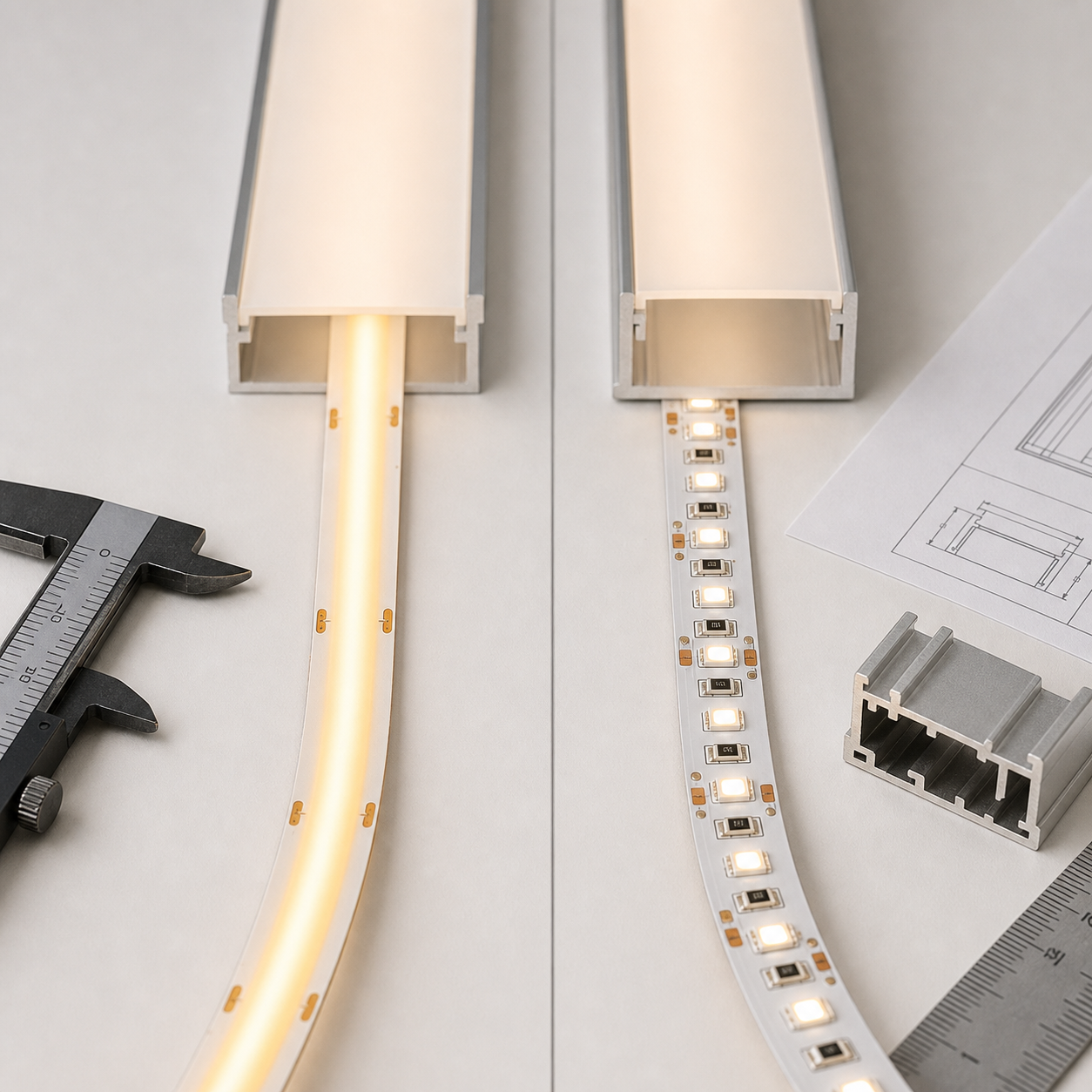
COB means chip-on-board. In a COB LED strip, many small LED chips are mounted closely on the strip substrate and covered with a continuous phosphor layer. This creates a more even light-emitting surface. When the strip is turned on, the line often looks smoother than a traditional dotted strip.
The biggest advantage is visual continuity. COB strips are popular for visible linear details, shallow aluminum profiles, cabinet lighting, premium retail shelves, hotel coves, mirror lighting, and decorative architectural lines where customers may see the strip directly or see it through a diffuser.
COB technology does not automatically mean every product is high quality. Buyers still need to check wattage, lumen output, CRI, CCT tolerance, copper thickness, adhesive quality, heat dissipation, IP rating, and driver compatibility. A smooth light line is only one part of the specification.

What Is an SMD LED Strip?
SMD means surface-mounted device. In an SMD LED strip, individual LED packages are soldered onto the flexible PCB. The LED packages are visible as separate light points, especially when the strip is installed close to a surface or behind a shallow diffuser.
SMD strips are widely used because they are mature, flexible, and available in many configurations. Buyers can choose different LED package types, densities, voltages, wattages, CCTs, RGB versions, RGBW versions, addressable versions, and waterproof structures. This make SMD strips useful for many commercial and decorative projects.
For many engineering buyers, SMD strips remain practical because they offer a broad range of price and performance levels. They are also familiar to many installers, which can reduce uncertainty on large projects.
COB vs SMD LED Strips: Quick Technical Comparison
| Factor | COB LED Strip | SMD LED Strip |
|---|---|---|
| Light appearance | Smoother, more continuous line | Visible light points unless density or diffuser is suitable |
| Best visual use | Dot-free lines, shallow channels, premium decorative lighting | General strip lighting, RGB effects, accent lighting, high-output options |
| Product variety | Growing, but usually narrower than SMD | Very wide range of power, density, voltage, color, and control options |
| Cost level | Often higher for comparable quality | Usually more price levels available |
| Diffuser need | Can look smooth with shallower diffusion | Often needs higher density, deeper profile, or better diffuser for dot-free effect |
| Engineering risk | Heat and bending details need careful checking | Dot visibility and color consistency need careful checking |
1. Light Uniformity and Dot-Free Effect
The most obvious difference is light uniformity. COB strips usually create a smoother line because the LED chips are covered by a continuous phosphor layer. This is useful when the strip is visible, installed close to a wall, or placed in a shallow aluminum profile.
SMD strips can also create a smooth effect, but it depends on LED density, diffuser depth, and installation distance. A low-density SMD strip in a shallow profile may show dots. A high-density SMD strip with a good diffuser can look much better, but it may require a deeper profile or more careful testing.
For premium projects such as hotels, luxury retail shelves, exhibition counters, villas, and architectural details, COB often gives the cleaner result. For hidden indirect lighting where the strip is far from the illuminated surface, SMD may be perfectly acceptable.
2. Brightness and Lumen Output
Brightness should be judged by actual lumen output per meter, not only by technology name. Some COB strips are designed for soft decorative lines, while some SMD strips are designed for high-output commercial lighting. The buyer should compare datasheets instead of assuming COB or SMD is always brighter.
For engineering projects, check:
- Lumen output per meter.
- Wattage per meter.
- Luminous efficacy, usually expressed as lm/W.
- Recommended maximum run length.
- Test condition for the published data.
The U.S. Department of Energy LED lighting guide is a useful general reference for LED efficiency and long-term lighting value. For professional buyers, efficiency should be considered together with optical quality and heat management.
3. Heat Dissipation and Reliability
Heat affects LED lifetime, color stability, adhesive performance, and driver load. COB strips have many LED chips packed closely together, so thermal design matters. SMD strips also produce heat, especially high-power versions, but the heat pattern may be different because the LED packages are separated.
For both strip types, aluminum profiles are strongly recommended in professional installations. A profile helps dissipate heat, protects the strip, holds the diffuser, and gives the installer a cleaner mounting surface. High-power strips installed directly onto wood, plastic, or poor thermal surfaces may fail earlier.
Buyers should ask suppliers for recommended profile types, surface temperature data, warranty conditions, and installation instructions. A strip sample tested in open air does not always represent performance after it is sealed into a long cove or outdoor channel.
4. Color Consistency and Binning
Color consistency is critical for hotels, retail chains, office buildings, and multi-site projects. If different batches have visible color variation, the project can look uneven even when the electrical installation is correct.
COB strips often look visually smooth, but they still need good CCT control and binning. SMD strips also require careful bin control because individual LED packages may vary. For large orders, buyers should ask about CCT tolerance, MacAdam step range when available, CRI, R9 if color quality matters, and batch consistency for repeat orders.
Do not approve a strip only from one short sample. Ask for samples from the actual production batch when possible, and compare them under the same driver and installation condition.
5. CRI and Application Quality
CRI affects how natural colors appear. A higher CRI is important for retail merchandise, hotels, restaurants, galleries, beauty spaces, and interior finishes. Lower CRI may be acceptable for basic utility lighting, but it can make products or materials look dull.
Both COB and SMD strips can be made in different CRI levels. Buyers should confirm CRI on the datasheet and, when needed, request test reports. For retail and hospitality projects, a cheap low-CRI strip can make the space feel less premium even when brightness is enough.
For complete interior lighting planning, LED strips can be combined with recessed downlights, track lights, and pendant lights.
6. Voltage Drop and Long Run Planning
Voltage drop is a common problem in long LED strip runs. It can cause the far end of the strip to look dimmer or slightly different in color. This issue is not only about COB or SMD; it is about voltage, wattage, PCB copper, wire size, power feed method, and total run length.
Many large projects choose 24V strips instead of 12V strips because 24V can reduce current for the same wattage. However, even 24V strips still need proper feed planning. Long runs may need power injection, parallel circuits, both-end feeding, or more distributed drivers.
We covered this in more detail in How to Select the Right LED Strip Light for Large-Scale Engineering Projects. For professional buyers, this electrical planning is just as important as choosing COB or SMD.
7. Dimming, Controls, RGB, and RGBW Options
SMD strips usually offer wider control options, especially for RGB, RGBW, RGB+CCT, and addressable designs. COB versions for single-color and tunable-white applications are common, but product variety may be narrower depending on the supplier.
If the project requires dimming, scene control, DMX, DALI, 0-10V, PWM, or smart control, confirm compatibility before ordering. The strip, driver, controller, amplifier, and wiring method must work together. A control problem discovered after installation can be costly to fix.
The DOE lighting controls overview explains common control types such as dimmers, sensors, and timers. For larger commercial projects, DesignLights Consortium resources can also help buyers think about lighting performance and control systems.
8. Waterproofing and Outdoor Use
Both COB and SMD strips can be supplied in waterproof versions, but buyers should check the structure carefully. IP rating, coating material, silicone sleeve, end-cap sealing, cable exit, connector type, UV resistance, and installation environment all matter.
Outdoor LED strip failures often happen at cut points and connectors. The strip body may be waterproof, but the installer may create a weak point during cutting or joining. For large projects, ask for clear installation instructions and decide whether factory-sealed lengths are safer than field cutting.
For exterior projects that need more than strip lighting, Enton Light also supplies outdoor lights, outdoor wall lights, step lights, and solar lights.
9. Installation and Maintenance
Professional buyers should think about installation speed and future maintenance. SMD strips are familiar to many installers and may be easier to source in replacement sections. COB strips may require more careful handling because the continuous luminous layer can be sensitive to sharp bending or rough treatment, depending on the construction.
For both types, check cutting intervals, solder pad size, connector compatibility, adhesive quality, profile fit, bending radius, and whether the strip can be replaced after installation. A beautiful lighting detail is not practical if it is impossible to service later.
10. Cost Comparison for Professional Buyers
COB strips often cost more than basic SMD strips, but the comparison is not always simple. If COB reduces the need for deeper profiles, expensive diffusers, or repeated mock-up changes, the total installed cost may be reasonable. If the strip is hidden far from view, SMD may achieve the same project result at a better cost.
Professional buyers should compare total system cost:
- Strip price per meter.
- Driver and controller cost.
- Profile and diffuser cost.
- Connector, cable, and labor cost.
- Failure risk and maintenance access.
- Visual quality required by the client.
The lowest strip price is not always the lowest project cost. A product that causes visible dots, color mismatch, or early failure may become much more expensive after installation.
When Should Buyers Choose COB LED Strips?
COB LED strips are usually a strong choice when:
- The project needs a smooth dot-free line of light.
- The strip is visible or close to the illuminated surface.
- The profile is shallow and dot hiding is difficult.
- The application is premium retail, hotel, villa, showroom, or architectural detail.
- The buyer wants a clean modern appearance with fewer visible light points.
COB is not automatically the best option for every project. It should still be tested for heat, bending, output, color consistency, waterproofing, and driver compatibility.
When Should Buyers Choose SMD LED Strips?
SMD LED strips are usually a strong choice when:
- The project needs a wide choice of wattage, LED density, voltage, or color type.
- The buyer needs RGB, RGBW, addressable, or special control options.
- The strip is hidden behind a good diffuser or installed far from the visible surface.
- The project needs a more flexible price range.
- Installers are already familiar with the product type.
SMD can deliver excellent results when the LED density, profile depth, diffuser, driver, and installation distance are selected correctly.
Specification Checklist Before Ordering
Before placing a bulk order for COB or SMD LED strips, professional buyers should confirm:
- Application: cove, shelf, signage, facade, stair, cabinet, or accent lighting.
- Required visual effect: dot-free line or acceptable visible LED points.
- Voltage, wattage per meter, and total project load.
- Lumen output, efficacy, LED density, and maximum run length.
- CCT, CRI, binning, and batch consistency.
- IP rating, coating structure, and cut-point sealing method.
- Driver capacity, dimming method, and control compatibility.
- Aluminum profile, diffuser depth, and heat dissipation plan.
- Cutting interval, connector method, and maintenance access.
- Certificates, test reports, warranty, and installation instructions.
UL Solutions lighting information is a useful reference for safety and certification thinking around lighting products and components. Certification needs vary by market, so buyers should confirm local project requirements early.
Conclusion: COB or SMD, Which Is Better?
COB LED strips are usually better when the project requires a smooth, continuous, premium light line. SMD LED strips are usually better when the project needs wide product variety, flexible pricing, high-output options, RGB/RGBW choices, or familiar installation.
The professional answer is not that one technology always wins. The better choice depends on the project effect, installation distance, profile depth, brightness target, control system, budget, and maintenance plan. Buyers should compare complete system performance, not only the strip type.
For LED strip lighting, indoor lighting, outdoor lighting, or full project lighting sourcing, buyers can browse the Enton Light shop, learn more about the company on the About page, or discuss specifications through the Contact page.
FAQs About COB vs SMD LED Strips
Are COB LED strips brighter than SMD LED strips?
Not always. Brightness depends on lumen output per meter, wattage, chip design, thermal management, and test conditions. Some SMD strips can be brighter than some COB strips.
Which LED strip is better for dot-free lighting?
COB strips usually provide a smoother dot-free effect, especially in shallow profiles or visible linear details. High-density SMD strips can also look smooth when paired with a good diffuser and enough depth.
Are COB LED strips more expensive?
COB strips are often more expensive than basic SMD strips, but total project cost depends on profiles, diffusers, labor, driver design, and the visual quality required.
Can COB LED strips be used outdoors?
Yes, if the strip has the correct waterproof structure and IP rating. Buyers should also check connector sealing, cut-point protection, UV exposure, and driver location.
Which type is better for RGB or RGBW lighting?
SMD strips usually offer wider RGB, RGBW, and addressable options. COB color versions exist, but availability and specification range may be narrower depending on the supplier.
Do both COB and SMD strips need aluminum profiles?
For professional projects, aluminum profiles are recommended for both types. They improve heat dissipation, protect the strip, hold the diffuser, and create a cleaner installation.
What should buyers test before mass production?
Test brightness, color consistency, dimming behavior, heat, dot visibility, voltage drop, IP sealing, profile fit, and installation method using the real driver and diffuser planned for the project.